Not in a long time, have I come across such a well crafted game, that keeps me engaged from start to finish.
INSIDE is the follow up to Playdead’s game Limbo, and borrows from Limbo’s dark universe. INSIDE is much more than a Limbo sequel. It features a mesmerizing world, fabulous art and an expertly fine tuned gameplay. This game is a rare jewel not to be missed.
A mysterious world

INSIDE is a 2D puzzle-platformer where you guide a young boy running away from danger to find an escape to the eerie world he’s in. On this journey, you need to help him evade patrols, outrun dogs, squeeze through defense systems and much more.
The journey starts in a forest at night. A young boy jumps out of bushes to stand on a rock. Before that, there is no cut-scene explaining who he is, where he comes from or why he’s all by himself in the forest at night.
As you start playing, you understand that people are after him. They don’t hesitate to shoot or send vicious dogs at him to stop his escape. You quickly realize that something is really wrong, and this is just the beginning. The boy gets exposed to increasingly disturbing situations as the story unfolds.
Gameplay
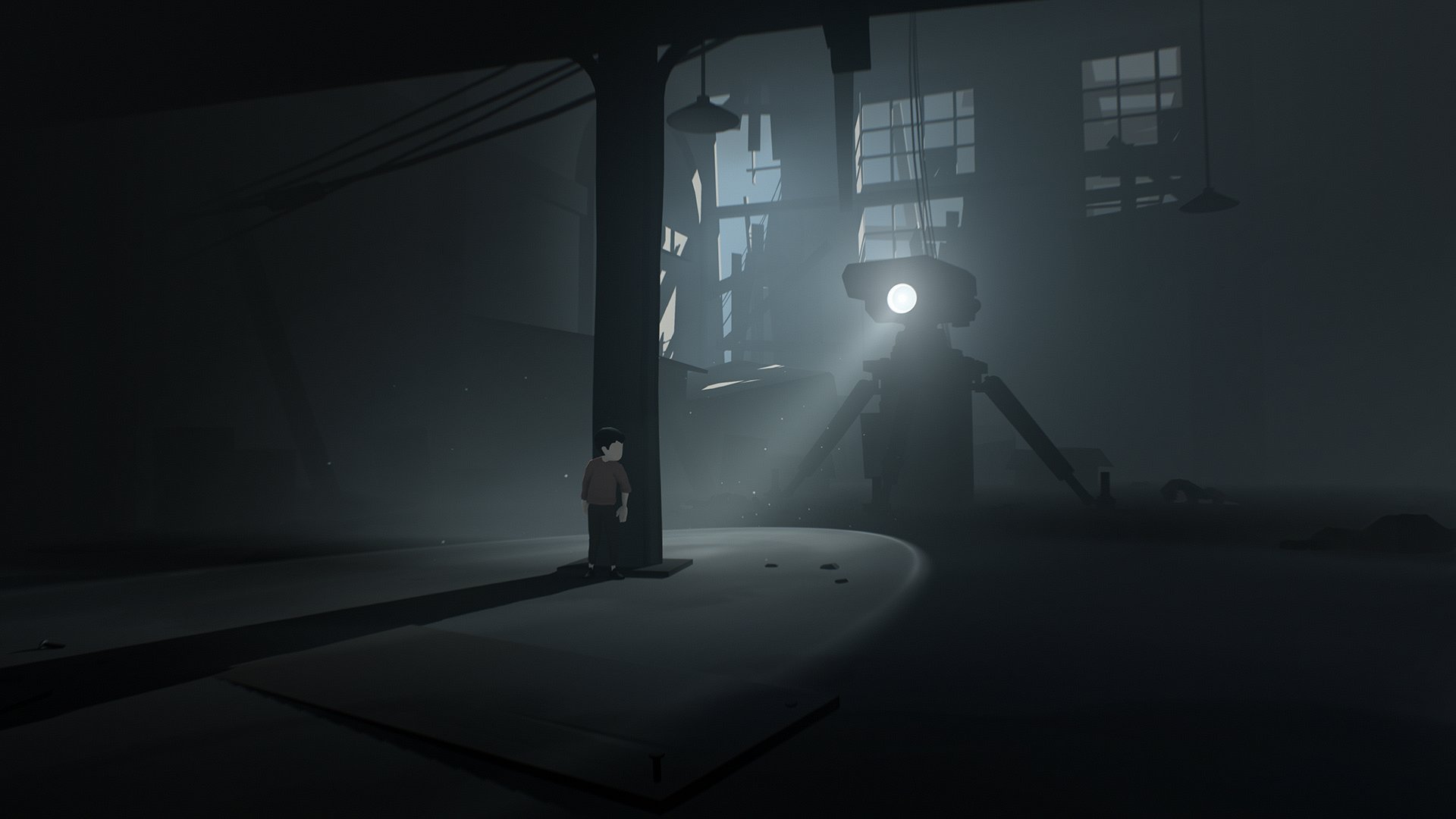
INSIDE is a 2D puzzle-platformer which can be played from start to finish in one sequence. There is no interruption or obvious checkpoint obstructing the experience. It plays mostly linearly from left to right, but the world representation is still in 3D, and while the action mainly takes place in the foreground, the background is where the story is told.
The first puzzles serve to get familiar with the controls and the mechanics of the game. After that introductory phase, they get increasingly engaging, fun and complex but never overly difficult. There hasn’t been a situation where I was stuck for a long time, and the solution elements were always in front of my eyes. Also, the game is very forgiving and, in case of failure, you will be re-positioned just before the failed puzzle. The puzzles span at most a few screen, with one notable exception, where the boy needs to gather help from different areas to pass a roadblock.
The controls are simple. Directional keys and an action button with a keyboard, or analog stick and two buttons with a gamepad. The boy reacts accurately to all of the commands. I played the whole game with a gamepad, which I think is the right controller for a platformer. However, the controls are simple enough that a keyboard will suffice if you don’t have a gamepad.
Immersion

INSIDE is the perfect example of how a title can have immersive graphics without a debauchery of explosive special effects that require the latest generation of GPUs. The camera angles, the muted colors, the atmospheric fog and lighting, all work together to present an utmost polished world to the player. Also, although this is a 2D puzzle-platformer, the scene are rendered in 3D. The background is used to tell the story of this world, but also to serve the game design. For example, chases are not confined in the 2D plane, and enemies come and go along the depth axis.
But it doesn’t stop here, fluid and realistic animations complement INSIDE’s art very well. Even the situation the boy is in can have an influence on the animation. Running can transition from a casual jog to a frenzied sprint soon after he gets chased. It is obvious that all animations got a lot of attention and even a peculiar life form around the end of the game will be fascinating to control. The game also relies on a physics engine to add realism to the interactions with inanimate objects.
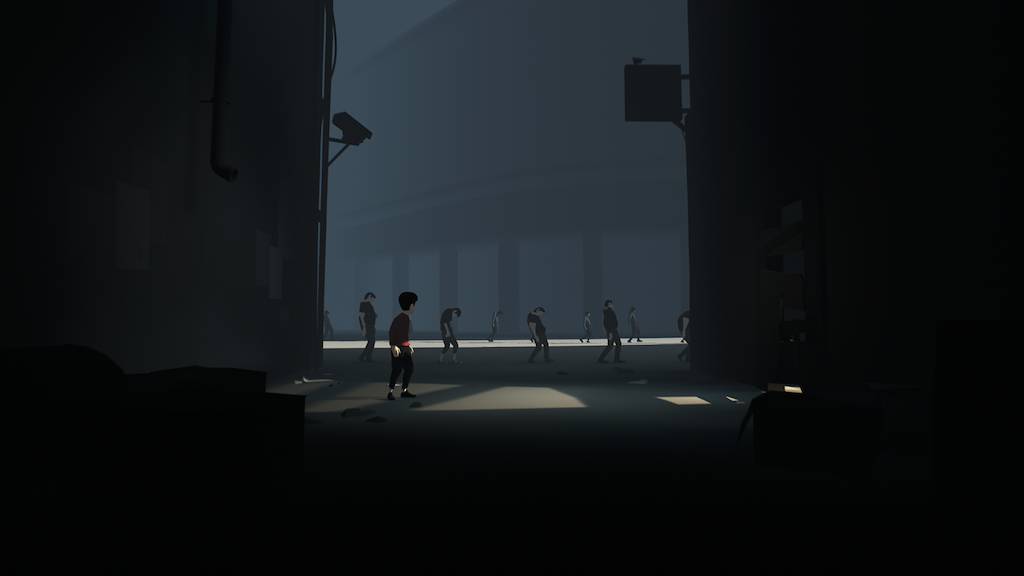
INSIDE’s visuals are such a success, that one would expect the same from the soundtrack. However, the game has no music, which could seem like an oversight at first. But as you play, you will realize that the game doesn’t need any music. I dare say a soundtrack would actually be a distraction from the already great experience. Indeed, no soundtrack doesn’t mean there is no sound. The environment noise matches each scene, then machines whirring, the boy breathing, water filling and emptying, valves opening and closing bring even more life to this world and improves immersion. The boy’s breathing and heartbeat intensifying in stressful situations will influence your mood.
The game immersion is then further strengthened by the lack of gameplay interruption (no checkpoint or loading screen),which makes the whole experience feel like being part of a movie. It doesn’t get any better than that, but I hope Playdead proves me wrong with their next game.
Final words
The only flaw to INSIDE is its little replay value. The game is rather short, and can be completed within an afternoon. However, this is easily forgiven considering how good the game is otherwise. Also its price point is much lower than that of a flagship title, being currently available for $19 on Steam. It is important to note that INSIDE doesn’t require a beast of a PC to run and as such, is a solid recommendation for all PC gamers.